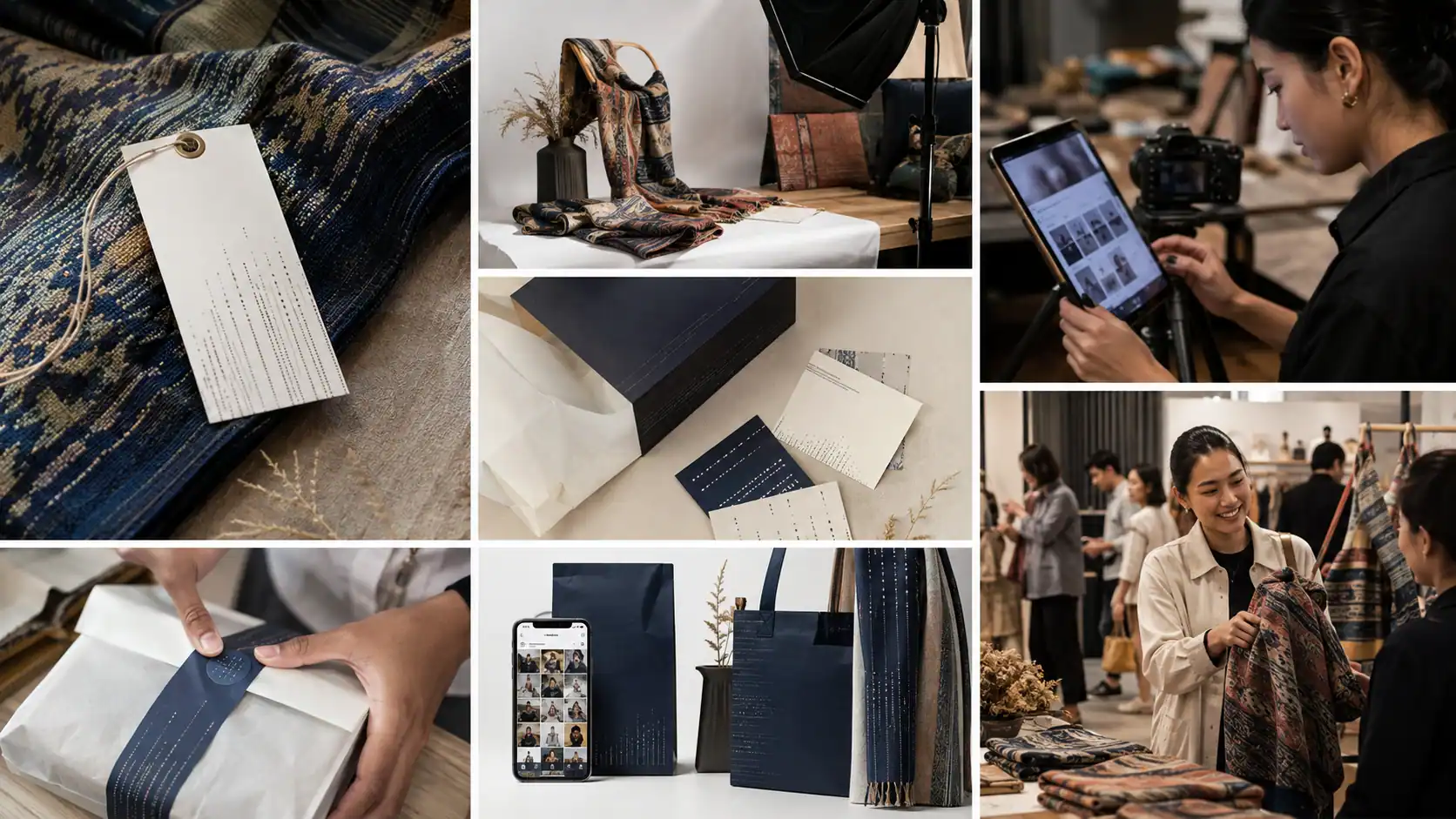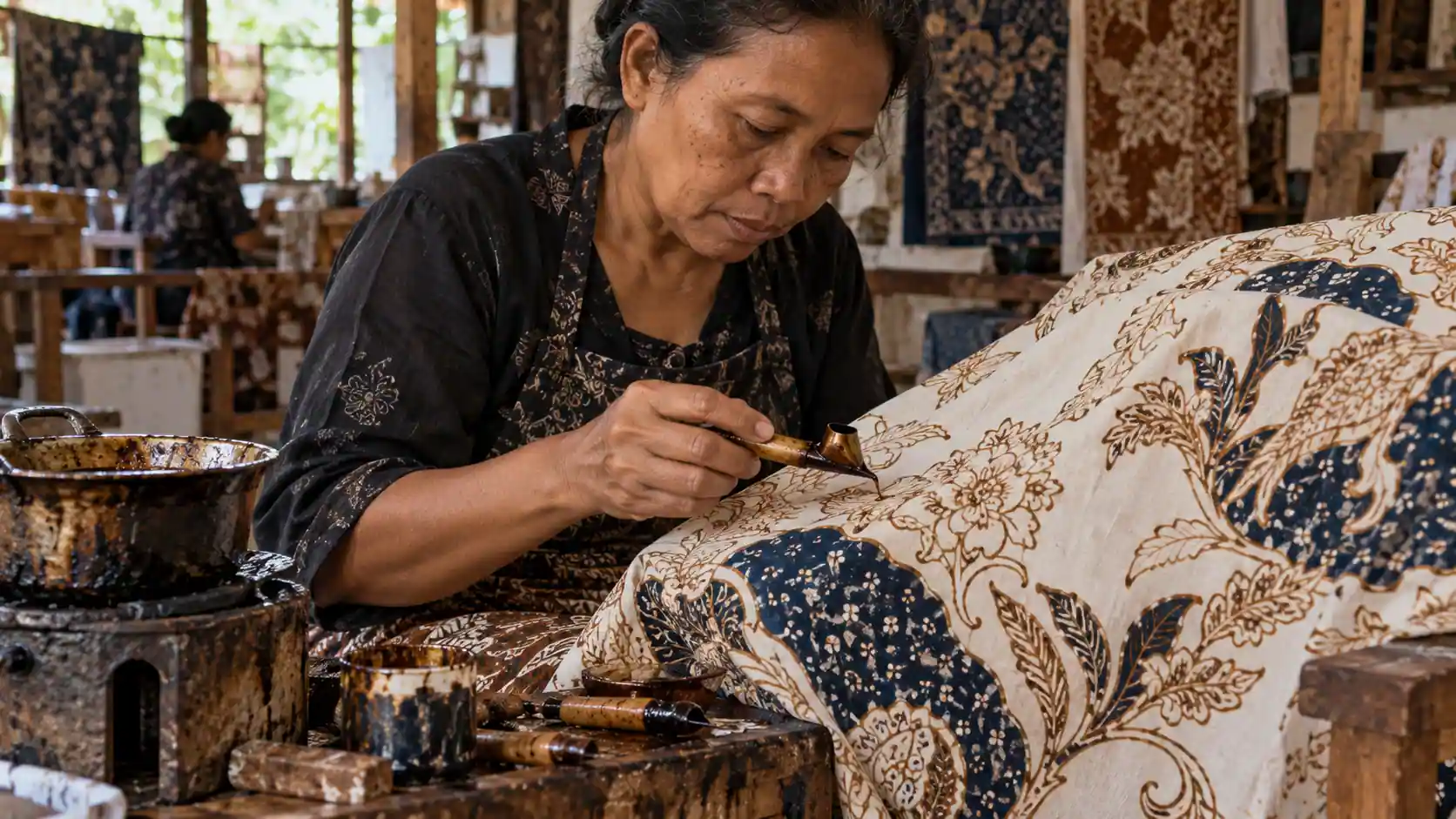

Every October 2, batik returns to the centre of public attention. Indonesia designated the date as National Batik Day through Presidential Decree No. 33/2009 after Indonesian Batik was inscribed on UNESCO’s Representative List of the Intangible Cultural Heritage of Humanity in 2009.[1][2]
UNESCO’s recognition, however, is not simply recognition of a catalogue of textile patterns. Its description covers wax-resist technique, symbolism, social use, craftsmanship and knowledge passed across generations. Batik is treated as living heritage.
That distinction matters commercially.
If batik is merely a pattern, a brand only needs to find an attractive visual and apply it to a product. If it is understood as knowledge, craft, identity and a community economy, the questions become deeper: who made it, where did it come from, how was it produced and how is economic value shared?
A batik motif does not automatically make a textile batik
Indonesia has a technical distinction that is often lost in marketing.
SNI 0239:2019, as referenced by the Ministry of Industry’s batik centre, defines batik through hot-wax resist processes applied with a hand canting, stamp canting or a combination. A printed textile reproducing the visual appearance without that process is not technically classified in the same way.[3]
Printed textiles are not inherently bad products. They have different economics and applications.
The problem begins when a printed product is marketed as though it contains craftsmanship, labour or process that it does not.
Transparency is therefore part of brand trust.
Provenance explains where value comes from
In wine, coffee, craft and luxury goods, provenance tells customers where a product comes from and how it came to exist.
The same logic can apply to batik.
Provenance may include the region, workshop or maker, technique, material, dyeing process, motif context and the designer’s own contribution.
That transforms a product from visual merchandise into something with traceable context.
Storytelling should follow evidence
Heritage gives brands powerful stories.
But the sequence matters.
Do not begin with the marketing narrative and then search for culture that fits it. Begin with the evidence: the maker, process, history, motif context and what the designer genuinely changed.
Credible storytelling is built from facts.
“Traditional” is not one homogeneous category
Indonesian batik is extraordinarily diverse.
UNESCO describes a long history of cultural influences, while Indonesia’s Ministry of Industry continues to identify distinct regional traditions and techniques.[2][4]
Nitik Yogyakarta, Complongan Indramayu and Batik Tulis Tenun Gedhog Tuban do not represent one interchangeable visual language.
Generic “Indonesian heritage” labels can therefore remove precisely the origin and specificity that give a product value.
Geographic Indications show that origin can have economic value
The Ministry of Industry lists Batik Tulis Nitik Yogyakarta, Batik Tulis Complongan Indramayu and Batik Tulis Tenun Gedhog Tuban among batik products facilitated and registered as Geographic Indications.[4]
In 2026, Indonesia’s intellectual-property authority and WIPO were also developing community-based pilots for non-agricultural GIs involving batik in Cirebon and Indramayu.[5]
Not every batik product requires a GI.
The broader principle is that place, human skill, reputation and product characteristics can form a commercially meaningful relationship worth protecting.
Heritage is not automatically a brand’s exclusive property
Companies also need caution around the language of “ownership”.
Indonesia’s intellectual-property authority distinguishes newly created individual designs from traditional cultural expressions maintained communally across generations. PP 56/2022 provides a framework for Indonesia’s Communal Intellectual Property, including Traditional Cultural Expressions and Traditional Knowledge.[6][7]
A brand may legitimately own a new design, trademark or other IP.
That does not mean the underlying cultural tradition becomes the company’s exclusive property.
Collaboration is stronger than extraction
WIPO has developed consultation guidance for fashion companies working with Indigenous Peoples’ Traditional Cultural Expressions. It is not a batik-specific Indonesian law, but the ethical principles are useful: identify legitimate holders or custodians, understand context, engage in dialogue, seek informed consent where appropriate, agree terms, provide attribution and consider fair benefit sharing.[8]
This suggests a more mature commercial model.
Artisans need not remain anonymous vendors at the end of a purchase order. They can become collaborators, knowledge partners and co-developers.
Attribution does not weaken the main brand
Some companies worry that naming makers or communities dilutes the master brand.
It can do the opposite.
Naming a region, technique, workshop or collaborator can increase credibility. The brand’s value shifts from pretending to be the sole source of everything toward being a trusted designer, curator and market connector.
Commercial value does not require invisibility of everyone else.
Artisans are part of the knowledge chain
Discussions about craft workers often focus on welfare.
That matters, but artisans also hold tacit production intelligence: how wax behaves, when fabric is ready, how defects are corrected and how quality is judged through experience.
This knowledge is difficult to document completely.
When skilled makers disappear, the industry loses more than labour capacity.
It loses know-how.
Regeneration is becoming business risk
The Ministry of Industry cited APPBI data showing the number of batik artisans falling from around 151,000 in 2020 to roughly 101,000 in 2024.[9] UNESCO has also recognised batik education in Pekalongan as a Good Safeguarding Practice because intergenerational transmission is central to continuity.[10]
For brands dependent on skilled craft, this resembles supply-chain risk.
A shrinking skills base can mean longer lead times, reduced capacity and greater difficulty maintaining quality.
Global recognition does not guarantee commercial growth
For the 2026 National Batik Day programme, the Ministry of Industry reported batik commodity exports of US$4.39 million in Q2 2026, down 13.76% from US$5.09 million a year earlier.[4]
That figure does not capture the entire batik economy.
But it is a useful reminder that UNESCO recognition does not automatically create sustained commercial growth.
Heritage can be globally famous while the businesses and skills behind it still face competitive pressure.
Cheap printed textiles create a positioning challenge
Indonesia’s Ministry of Industry has specifically highlighted competition from mass-produced printed fabrics carrying batik-like motifs.[11]
The strategic response should not be hostility toward production technology.
It should be clearer value communication.
If hand or stamped batik requires more time, skill and process, consumers need to understand why the product costs more.
Without education, craft simply looks expensive.
Do not turn artisans into visual props
Heritage campaigns often use artisans as evidence of authenticity.
Hands, workshops and craft processes make powerful photography.
But if suppliers are pressured relentlessly on price or disappear from attribution after the campaign ends, the imagery becomes performative.
Brand responsibility needs to appear in procurement and economics—not only in creative direction.
Premium prices need verifiable reasons
“Heritage”, “artisan” and “limited edition” are easy labels to use.
A premium should be connected to something tangible: stronger materials, skilled labour, longer processes, limited capacity, fairer compensation, provenance, design development or better finishing.
A story without underlying substance eventually becomes a liability.
Scaling does not mean making everything mass-produced
Growing brands inevitably face a tension between craft intensity and volume.
One answer is segmentation.
A core line can retain labour-intensive hand batik. Other products may use stamped batik, different textile techniques or contemporary interpretations—provided the distinction is communicated honestly.
Not every product needs the most expensive process.
It simply should not pretend to be something it is not.
Provenance can become a system
A heritage-focused brand can create a basic provenance record for every product:
maker or workshop;
region;
technique;
material;
motif or source of inspiration;
new designer contribution;
attribution wording;
and compensation or quality arrangements.
Once recorded consistently, provenance becomes product data rather than advertising copy.
National Batik Day should bring attention back to the value chain
Presidential Decree 33/2009 describes National Batik Day as a means of increasing awareness around the protection and development of Indonesian batik.[1]
Both words matter.
Protection without development can freeze living heritage. Development without protection can strip away the knowledge and context that created its value.
Brands do not need to stop innovating.
They need to know what they are transforming, who contributed and how value returns to the ecosystem that made innovation possible.
Batik is visible through pattern.
Its deeper value lives in people, place, technique, time and knowledge.
- [1] Government of Indonesia. Presidential Decree No. 33/2009 on National Batik Day.
- [2] UNESCO. Indonesian Batik — Representative List of the Intangible Cultural Heritage of Humanity.
- [3] Ministry of Industry, Balai Besar Kerajinan dan Batik. SNI 0239:2019 — Batik terminology.
- [4] Ministry of Industry. National Batik Day 2026, September 18, 2026.
- [5] DJKI. DJKI–WIPO cooperation on non-agricultural Geographic Indications, March 31, 2026.
- [6] DJKI. Communal Intellectual Property.
- [7] DJKI. Copyright, Industrial Design, Traditional Cultural Expressions and Geographic Indications, January 12, 2026.
- [8] WIPO. Traditional Cultural Expressions and Fashion.
- [9] Ministry of Industry, citing APPBI artisan data.
- [10] UNESCO. Education and Training in Indonesian Batik — Good Safeguarding Practice.
- [11] Ministry of Industry. Preserving Authentic Batik in Puspa Nuswantara 2026.
- UNESCO recognition concerns Indonesian Batik as intangible cultural heritage and should not be interpreted as a blanket commercial monopoly over every motif. Technical references distinguish wax-resist batik from printed batik-style textiles. WIPO principles are used as an international ethical reference rather than batik-specific Indonesian law.
Published: September 27, 2026